Showing posts with label Garden. Show all posts

Tuesday, March 20, 2012

Onions!

This year's garden experiment is in onions.  The bulb kind, not the scallion kind.  There appears to be a lot of debate in the gardening world between the people who grow sets, and the ones who grow their onions from seed.  I did sets last year, and they did well enough...except for storage.  My onions lasted about a month, then got soft and started rotting from the inside out.  But that's what you get when planting red or sweet varieties; they just don't store as well as yellows.

But this year I want more.  Many more, actually.  And according to the forums, one can grow bigger onions from seed than one can from a set.  And provided that I can cure my onions properly, it's possible I can provide enough onions for nearly 9 months of our eating them.

Onions are pretty easy, really...provided that you start them early enough.  I was supposed to start them in the fall, but I guess Valentine's Day will just have to be good enough.  If worse comes to worst, I'll just be harvesting them later in the summer than I had originally planned.

Get the seed


Plant them in the pots


Can I help, Mommy?


Keep them warm!


A week later, baby onions!

I'll keep updates on how they're doing.  Right now they're about a month old, and still looking chive-like and frail.  But every day I "pet" them to simulate the wind and make their stems grow straight and strong.  On nice days, I harden them off a bit outside.  When they get to be about 6 inches tall and about as thick as a pencil, they'll find a home outdoors for good.

Wednesday, February 15, 2012

Garden Planning

The mild winter certainly has been giving me "the itchy paws" for gardening!  The late part of winter is the perfect time for us gardeners to curl up with our newly-arrived seed catalogs, take stock of what worked (and what didn't) last year, and start planning what we want our gardens to look like this year.

For me, I'm going to be doubling last year's growing space...150 square feet to 350.  Scary, isn't it...350 square feet of garden space is nearly the same size as my first apartment!  My hope, though, is to grow enough food to supplement our grocery budget for at least 6 months.

Here's the list of things I'm growing:

  • Paste Tomato (Determinate):  Roma & Bellstar
  • Paste Tomato (Indeterminate):  Amish Paste & San Marzano
  • Bell Pepper:  California Wonder & Chinese Giant
  • Hot Pepper:  JalapeƱo & Elsita
  • Potato:  Yukon Gold
  • Onions:  Cortland Yellow
  • Winter Squash:  Waltham Butternut & HoneyNut Mini
  • Greens:  Tyee Spinach
  • Lettuce (Greenleaf):  Black-seeded Simpson
  • Lettuce (Bibb):  Buttercrunch & Pirat
  • Lettuce (Romaine):  Freckles, Winter Density, Jericho
  • Carrot:  Danvers 126
  • Peas:  Sugar Snap
  • Flowers:  Nasturtium
  • Herbs:  Basil, Mint, Cilantro, Parsley


Sure, it sounds like a lot of plants, but it really isn't.  Everything on this list is something we eat on a daily basis, or can be preserved via canning or freezing.  As for the seed, 75% of it is left over from last year.  Germination rates are still high for 1 or 2 years after seeds were initially harvested, provided you store them in a cool, dry place with constant humidity levels.  For me, the pantry closet works wonders.  

As with all things, it's very important to plan and organize before you start planting.  This prevents you from getting overwhelmed, starting more plants than you have space for, or just flat-out being disorganized.  I HATE being disorganized!

Besides, it can be a lot of fun on a winter evening (I used the SuperBowl as the perfect opportunity) to grab a couple sheets of graph paper, a ruler, and a pencil to see what creativity you can spark.  Check the spacing allotments located on your seed packets, and go to town!

Happy planning!

Monday, October 10, 2011

Garden Clean-Up


Like all good things, gardens come to an end too.


But what a lovely day to do it!  Blue skies and puffy clouds...perfect fall weather!


It was a good year; eggplants, tomatoes, potatoes, flowers, herbs, peppers, squash, corn...they all made it to the table.  And now, this is all that's left...

So now it's time to put the garden to rest for next spring.

But it's such a big job...


Honors Students to the rescue!!


What would we have done without them??
So many things to be done!


Collect what's left!


Do you see anything you want to take home?

Tomatoes, perhaps?


Tear down anything that moves!


Pull what you can...we don't want to see those weeds growing next year!


Got tomatoes?


Where should we put this stuff?
We can't throw it away...


Got it covered; we're building compost bins!
First we'll dig the holes and set the stakes.


Is that sledgehammer big enough to handle the job?  How about the ladies wielding it?  Be careful; you don't want to miss!


Then we'll put up fencing to keep it all inside...


And fill it to the brim!


We'd be lost without our volunteers...


And Wayne's truck, for that matter...


Isn't it amazing how a small group of strangers can come together and get so many things done?


Time for socializing!


And goofing around..."American Gothic" style!


And for having pictures taken with people we won't see for awhile!


With only a few lone tomatoes left behind...


Our garden rests quietly until Spring.

Tuesday, September 13, 2011

Homemade Fertilizer

Not every person is happy to say, "I've got worms."  Gardeners, on the other hand, will shout it joyously to every corner of the universe if you'd let them.  And why shouldn't we?  Worms do so many things for us, for our plants, and for the soil.

Worms are Nature's fast-track garbage disposals, daily ingesting their body weight in plant waste and depositing the waste (politely called casts or castings) in a form that plants can use.  Unlike the wastes of many other animals, worm castings are actually more nutritious coming out than they were going in.  Excellent fertilizer, in other words.  Cultivated worm waste, also called vermicompost, can contain 8 times more nitrogen than compost alone.

Feeling squeamish?  That's a perfectly normal reaction, but there's really nothing to worry about.  Worms' digestive tracts contain no bacteria, so we don't have to worry about nasty things like salmonella or E. coli in worm castings.  Worms are vegans, consuming absolutely no animal products or oils of any kind, so there are no smelly by-products released during their waste production...meaning that you can keep them in your garage or basement, and they'll happily make all the fertilizer you could ever need.

Really, it's easy.  All you need is a 10 gallon tote with a small hole drilled in the side, some moistened shredded paper, a bowl of chopped (meatless) kitchen scraps, and a handful of red worms.


The variety of worms is very important.  Red worms, also known as red wrigglers, are the best species of worm to start making vermicompost.  In the wild, they occupy the top 6 inches of soil, ingesting organic matter and leaving their castings behind them.  Most of the worms you see on the sidewalk after a big rain are actually nightcrawlers, not red worms.  The difference between them and red worms is that nightcrawlers are HUGE.  They require more space than red worms, often digging up to 6 feet beneath the soil surface!  So obviously not a good choice for a 10 gallon tote, or even a 30 gallon one.  Red worms can be purchased from bait shops, the internet, or donated from a friend who also has a worm bin.


It doesn't take much to get a worm bin going.  Just moisten the shredded paper to very-wrung-out sponge level, put the worms in, and give them a bowl of kitchen scraps.  If you're just starting out, a bit of sand or garden soil would also be helpful; worms don't have teeth, and need to ingest small rocks to help the food move through their digestive tract.  They'll eat just about anything; just be careful about hot peppers, onions, potato skins, garlic, and high-citrus fruits like tomatoes.  They don't like those too much, and you'll eventually have to pick them out later.  But anything else is fair game:  celery, carrot, apple, banana, bell pepper, moldy bread, zucchini, eggplant, cooked pasta or rice, lettuce, cabbage, spinach...the list goes on forever.


Worms like places that are moist and dark, so I like to bury the food in a corner, kind of sandwiched in on top of some paper, and then bury it under a layer of newspaper to discourage fruit flies.  You'll have to add more shredded newspaper eventually, but don't stress about it.  Just add more as you need it.  I use my shredded bills and credit card offers for their bedding.  By the time our shredder is full again, it's just about time to give the worms fresh bedding.


Then, you wait.  I usually don't feed my worms more than twice a month.  They don't need much attention, really.  Just keep them in a place where the temperature is between 50 and 75 degrees Fahrenheit, and they're happy.  And they reproduce like crazy, doubling their population every six weeks; so even though the start-up is slow, they'll soon eat you out of house and home!


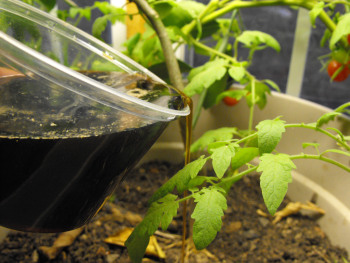
The best way to use the vermicompost once it's done is in a compost tea.  Tea is created when you dissolve the castings in water for about 24 hours, then strain it to remove any debris.  I like to use vermicompost tea in a 1:6 solution to prevent fertilizer burn on my plants.  And the plants love it!  Truly, my home-made vermicompost puts Miracle-Gro to shame...and it's free, which is another added bonus.

Wednesday, September 7, 2011

Autumn Garden Prep

It's so cold and blustery this week in Central Indiana!  Thanks a lot, Tropical Storm Lee...thanks a lot.  But on the positive side, this sudden shift in the weather gets me thinking about the changing of the seasons.  Autumn is coming, and with it means putting the garden to bed...while welcoming apple season with open arms!

We only have a few weeks left of good harvest time left, and my garden plants know it; production is starting to slow down a bit.  But just because the harvest is over doesn't mean we gardeners get to take a rest!  Autumn is the season in which we must prepare the soil for next year's planting.  The work's just begun.

Unfortunately, a lot of people forget this part.  Whoops.  I know what you're thinking; I get it all the time:  "Come on, seriously?  Of all things, why is it important to prepare the soil for next year?  Doesn't it just sit there, waiting?  That's all it needs, right?"

WRONG.  Soil is a natural resource, and a preciously fragile one at that.  And probably one of the most overlooked, simply because it's EVERYWHERE you look.  But good soil is a special thing indeed:  a gardener can have the blackest thumb in the world, but so long as the soil he's working is good, his garden will be beautiful.  Conversely, an award-winning gardener can do everything right by bad soil, and his plants will still die.  Plants require a good soil to live, and one thing we can do is manage that growing medium so that it will continue to support life.

So here are a few suggestions on how to get your garden (soil) ready for winter:

1.  Clean House.  Remove all plants, vines, dead leaves, spoiled fruits, weeds, and mulches.  If they're not diseased, toss them in the compost pile.  They'll break down over winter and form a good growing medium for you to use next year.  The reason for this is to prevent insect pests from having a place to hibernate over the winter months.  If there's no shelter in your garden, they won't lay their eggs there...and the troublesome offspring hatching from those eggs will be less likely to chew on your plants!


2.  Amend the Soil.  Here you've got options.  If you have aged manure or compost available, spread a layer 1 - 3 inches deep over the top of your growing area and till it into the soil with a spade, hoe, or mechanical tiller.  If you're buying manure/compost from the store, you'll want about 20 lbs per 100 square feet.  The compost/manure will decompose into the soil, releasing the nutrients so they'll be available for the plants come spring.  It's smelly and hard work, to be sure, but your plants will thank you!


You can also do a cover crop, sometimes called "green manure."  This technique involves sowing a mix of legumes and grasses about 4 - 6 weeks before frost, which is about Autumn Equinox here (Sept 21-23).  Plants included for winter cover crops are winter wheat, crimson clover, and rye.  Some sources say to plant hairy vetch or mustard in the mix...but these plants are invasive in Indiana.  If they flower or go to seed, you'll have a HUGE problem on your hands, and will have a very difficult time getting those weeds under control.

The plants in a cover crop will germinate and establish themselves before the frost, then go dormant during the coldest part of winter.  They'll grow a bit during mid-season thaws, but mostly their purpose is to fix nitrogen in the soil and prevent the soil from becoming compacted or eroded during the cold season.  Four to six weeks before the last frost in spring, about the Spring Equinox here (March 21-23), chop the plants down to the ground with a weed eater or loppers, and till everything into the soil.  The plant material will decompose quickly, and provide nutrients for the growing season.

The key is to NOT let any of those grasses or clovers flower or go to seed.  You don't want them to reproduce; just grow and die.  You shouldn't need a whole lot of seed to do this; just a pound or two of each cover crop should be enough to cover 1000 square feet.


3.  Cover the Soil.  If all else fails, and you can't get your hands on compost, animal manure, or cover crop seed, cover the soil with leaves.  This will prevent the soil from blowing away during winter, and will prevent the worst of the elements from weathering it.  But be careful; you don't want to till the leaves into the soil.  Fallen leaves have a high carbon content, and the microorganisms in the soil will use up any nitrogen left over from the growing season to decompose them.  Best to simply use them as cover, and then pull them off in spring when you're prepping the garden.


Happy Autumn Prepping!

Wednesday, August 31, 2011

Harvest Season


The seasons are on the brink of change again, and harvest time is in full swing at my garden.  Let's take a quick look at what I've gotten thus far:


Cilantro.  Granted, I didn't know what I was doing with it, and didn't harvest often enough when it was a small plant.  Then the weather warmed and the plant began flowering.  When cilantro flowers, it's then called a different name entirely:  coriander.  It's still edible at this point; now it's just the seeds that are harvested and used in Indian dishes.  You could still use the leaves, I suppose, but I'm not sure how good they taste.  I need to research that some more.  But it hardly matters at this point; the stems have dried out and I tossed the whole thing into the compost.


Basil.  I've learned a lot from this herb, also:  harvest early, and often.  Clipping it back aggressively every week or two doesn't appear to hurt it in the slightest.  In fact, the leaves become more vigorous and bushy with every cutting.  Though when basil flowers, the plant does wonders to attract pollinators.  But watch out, because you'll get good ones along with bad.  I've used my basil in soups, in pesto, dried it, and I've still got it coming!


Mint:  same rules as basil.  Not surprising in the slightest, really; they're in the same botanical family.  They grow in a similar fashion and location, are harvested the same way, and have similar pests that like to eat them. (Including humans).


Onions.  These were one of my favorite things to grow!  Vigorous, having little insect damage, and edible at any stage of its life.  We ate bunches of fresh green onions this year, and STILL had enough bulb onions left over for harvest!  We got 10 lbs out of our garden, easy.


Corn.  Though tasty, I probably won't grow this again.  Corn is quite a needy crop, flopping over during a windy day, vigorously sucking every available nutrient from the soil, not growing well next to other plants, and needing WAY more fertilization mid-season than I was willing to provide.  But I got 2 lbs of corn off the cob and safely stored into my freezer, so I count that as a success.


Jalapeno.  My bell peppers may have flopped this year, but these are doing pretty well.  I've gotten some green ones, and then forgot about them for a bit and harvested some red ones, also.  Did someone say salsa?


Tomatoes.  These are my babies; that's why I saved them for last.  I didn't expect to love them as much as I did.  But now I know why the tomato is America's favorite crop...tomatoes are easy and fun to grow, vigorous producers, and gorgeous.  I often found myself making excuses just to go out and play with them:  pruning branches, training the vines, cutting out blighted leaves, watering, fertilizing, weeding, stabilizing trellises, tying additional supports for sprawling vines...the list goes on.  And apparently my work paid off; I've harvested 60 lbs so far...and the plants are still going strong!


Monday, August 22, 2011

Tomato Season!

In my world, August is the season of the tomato.  For some gardeners, the season starts earlier...but I decided to use heirloom varieties this year instead of the plethora of hybrids available as seed, or as transplants at most garden centers in our area.  That means my season starts later than that of other tomatoes.

Nothing against the popular Big Boy, Better Boy, or Early Girl varieties - my garden neighbors have allowed me to take enough of these cultivars to be quite familiar with them - but my garden's goal was canning.  The transplant-ready beefsteak varieties would have worked, but I had loftier goals.

I wanted local, heirloom, uniquely named, canning-style tomatoes.  And for the most part, that's what I got.  But then, the romantic names such as "Green Zebra" and "Red Brandywine" and "Pineapple" distracted me.

"What fun it would be to grow these," I thought.  And indeed, they were fun...but as fun as they were, these cultivars weren't exactly ideal for canning.


Now, just because a variety isn't "specially selected" for canning doesn't mean you can't use it for that purpose.  A Brandywine can find its way into a pint-sized canning jar just as well as a Roma or Amish Paste.  But as I found out the hard way, it just means that you'll have a lot more juice, and not a lot of "meat" in the tomato's wall lining.  In other words, a lot of work to peel and seed the tomato without a lot of reward for the effort.


Great....that means that nearly 26 pounds of tomatoes harvested in a single week boiled down to 5 pints of canned diced tomato.

But on the up-side, they look AMAZING!


There would have been much less work for me had I grown more of these:


This mango-sized beauty is the Amish Paste.  It originally hails from the great state of Wisconsin, and I LOVE THIS TOMATO!!!  Very few seeds, thin skin, and all meat.  Pretty disease resistant, too.  I've had some trouble with blight and insects, so every little defense counts.


But isn't that what gardening is all about?  Learning from things that didn't work as well as you'd hoped.  And it's been fun, seeing the little plants poking their heads out of the soil, then sending out the yellow flowers, and finding tiny green tomatoes hiding within the foliage.

And harvesting!  It's like an Easter-egg hunt, only better...because you can come back to the same hiding place again and again...and always find another ripe tomato, just waiting.